Reading Your Tires Like a Mechanic: What That Wear Pattern Is Really Saying
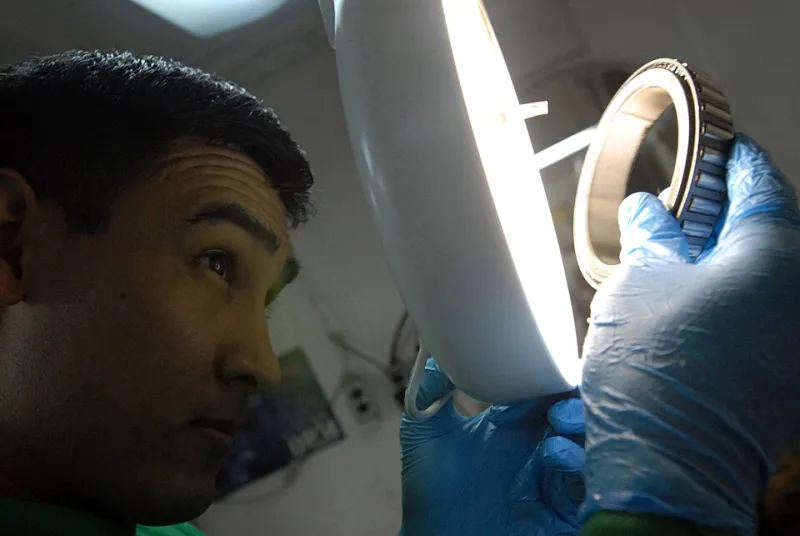
Photo: U.S. Navy photo by Photographer's Mate 3rd Class Dominique M. Lasco, Public domain, via Wikimedia Commons
Around here, we'll pull a car into the bay, run a hand across the tread, and know a whole lot about how that vehicle's been living its life. Tire wear is like a diary — every bald stripe and jagged edge tells a story. The good news? You don't need twenty years under the hood to read it. You just need a couple of minutes and this guide.
Why Bother Checking?
Because catching a wear pattern early is the difference between a free pressure adjustment and a $600 set of new rubber. Tires are the only part of your car actually touching the road — all four of them, each about the size of a human palm. When something's off, they'll tell you. Here's how to listen.
Worn Down the Middle: Too Much Air
If the center of the tread looks bald while the shoulders still have plenty of life, your tires are overinflated. The tire balloons slightly, riding on the middle of the tread like a guy walking on his tiptoes.
The fix: Check your door jamb sticker (not the number on the tire sidewall — that's the max, not the recommendation) and let some air out. Most passenger cars want somewhere between 32 and 35 PSI.
Chewed-Up Edges: Too Little Air or Hard Cornering
The opposite problem. When both outer edges wear faster than the center, the tire is underinflated and flexing at the shoulders. If only one edge is worn, that's usually an alignment issue instead — the wheel is tilted and dragging the tire sideways down the road.
The fix: Air up to spec first. If the single-edge wear sticks around after a few weeks, come get an alignment check.
Cupping: The Suspension Tell
Cupping looks like a series of scoops or scalloped dips around the tread — almost like someone took an ice cream scoop to your tire. This one almost always points to worn shocks, struts, or bushings. When the wheel bounces instead of rolling smoothly, it skims and slaps the pavement, carving out those dips.
The fix: New tires alone won't solve it. The suspension part needs replacing first, or the cups will come right back on the fresh set.
Feathering: Smooth One Way, Sharp the Other
Run your palm across the tread (careful of cords). If the tread blocks feel smooth going one direction and jagged like saw teeth going the other, that's feathering — a classic sign the toe alignment is out of spec. Your tires are scrabbling sideways a little bit with every rotation.
The fix: A four-wheel alignment. And honestly, this is one worth fixing fast, because feathering chews through tread quicker than just about anything else.
The 60-Second Driveway Check
You don't need a lift. Grab a flashlight and do this once a month:
- The penny test — Stick a penny into the tread with Lincoln's head down. If you can see the top of his head, you're under 2/32" and shopping for tires.
- Walk-around — Look at all four tires from the front, back, and sides. Compare left to right.
- The palm sweep — Feel across each tread. Smooth? Bumpy? Scalloped? Note what you find.
- Pressure check — A $10 gauge from any parts store pays for itself the first month.
When to Come See Us
Some things you can handle in the driveway. Others — alignments, suspension work, rotation schedules — are easier with the car on a lift and a set of trained eyes on it. If you spot cupping, feathering, or wear that's uneven side-to-side, swing by the shop. We'll take a look, tell you straight what's going on, and give you an honest answer about whether it's a five-minute fix or something bigger.
No pressure, no upsell — that's just how we do things around here. Your tires are talking. We're happy to translate.